Record
Capture raw PPG, ECG, EEG, and IMU sessions across device platforms.
Record, assure, generate, build, trigger, run, deploy, and monitor — one workbench.
Wearable teams stitch together a notebook, a spreadsheet, and a Slack thread instead. Phantom brings the entire lifecycle into one workbench.
Capture real device sessions and quality-gate the signal before algorithm evaluation. SNR, motion artifacts, and placement confidence on every window.
Generate synthetic variation that recruited cohorts cannot reach, then build and iterate algorithm logic within one continuous environment.
Simulate real-world conditions and run algorithms across population variants for a coverage report — not just one average accuracy score.
Deploy compiled algorithms directly to target hardware and watch performance live to isolate hardware, firmware, or placement drift.
RAEH Phantom is the one place a wearable algorithm gets recorded against, quality-checked, tested against variation you couldn’t recruit, built, deployed to a real device, and watched live.
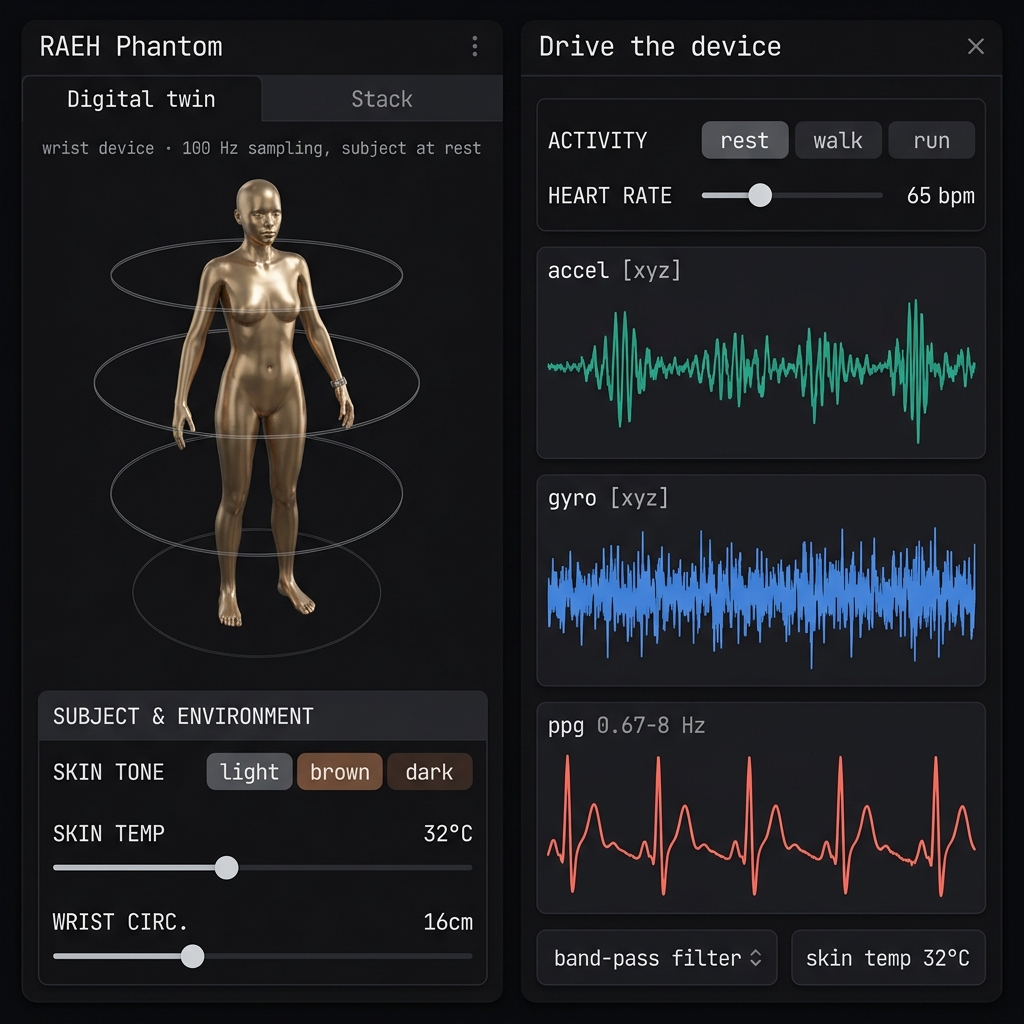
Quality-gate raw device signals before algorithm evaluation.
Test variation and edge cases no recruited cohort reaches.
Validate algorithms against Phantom-generated synthetic signals.
Ship directly to target hardware and watch performance live.
A single accuracy score hides where an algorithm fails. RAEH reports where it breaks, not just how well it scores on average.
At t=58s this record's own confidence bottoms at 0.91 — exactly where its PPG and ECG heart-rate estimates disagree by 9 bpm. Below the 0.95 threshold every biomarker relays to hold.
Capture raw PPG, ECG, EEG, and IMU sessions across device platforms.
Automatic artifact detection, SNR verification, and signal quality-gating.
Create physiological, motion, and fit variation no recruited cohort reaches.
Test real-world conditions across populations for a full coverage report.
Compile and ship validated algorithm logic directly to target hardware.
Watch live device streams to isolate hardware, placement, or model drift.
The workbench is the first infrastructure layer. Everything that loop produces builds the interpretation layer underneath it.
The IDE is the only place a continuous, attributed stream of real biosignal data gets produced.
The same backbone across every deployment target.
Report where an algorithm breaks across variation, not just one average score.
Quality-gate raw vitals and SNR before algorithm evaluation.
What the backbone learns from one modality carries to the next.
When a metric moves — hardware, firmware, placement, or the algorithm? RAEH Phantom gives wearable teams one workbench to record, test, and debug regressions in code.
import raehraeh.api_key = "raeh_sk_live_..."# 30 s of single-lead ECG at 250 Hzecg = load_recording("session_01.npy")result = raeh.signals.analyze( signal=ecg, modality="ecg", sample_rate=250,)print(result.heart_rate)Python + TypeScript, full type hints.
Semantic versioning, no surprise breakage.
Record, assure, generate, build, trigger, run, deploy, and monitor — one loop instead of six disconnected tools.
BECOMING THE FOUNDATION EVERY WEARABLE BUILDS ON